Nava x Privy: Enabling AI Agents to Transact from Wallets Securely
Nava gives AI agents secure, scoped access to user wallets built on Privy. No app secrets, backends, or private keys. One browser-based OAuth flow spans CLIs, MCP servers, and skills, so agents transact autonomously within boundaries we control.

Written by Nava Labs

At Nava, we build the verification layer that lets autonomous agents move real money safely. Privy's new scoped authorization gives an agent wallet authority for specific actions. Nava verifies whether each proposed use of that authority should be allowed. Agents are useful because they reason creatively, and risky for the same reason, because when they're wrong, funds are lost. Nava closes that gap with independent verification and expressive, protocol-specific transaction constraints, so your agent keeps its creativity in execution and your users keep certainty in outcome.
It starts with scoped access
Privy's new authorization flow lets an agent prompt the user to approve specific wallet actions. Your user authorizes once through a browser-based flow: the agent initiates an OAuth device authorization grant, displays a short code, and the user signs in, reviews the exact permissions requested, and approves. From there the agent can act without ever handling private keys or credentials directly, and you never embed a Privy app secret or signing key in your agent environment. The flow stays consistent across CLIs, MCP servers, skills, and other agent surfaces.
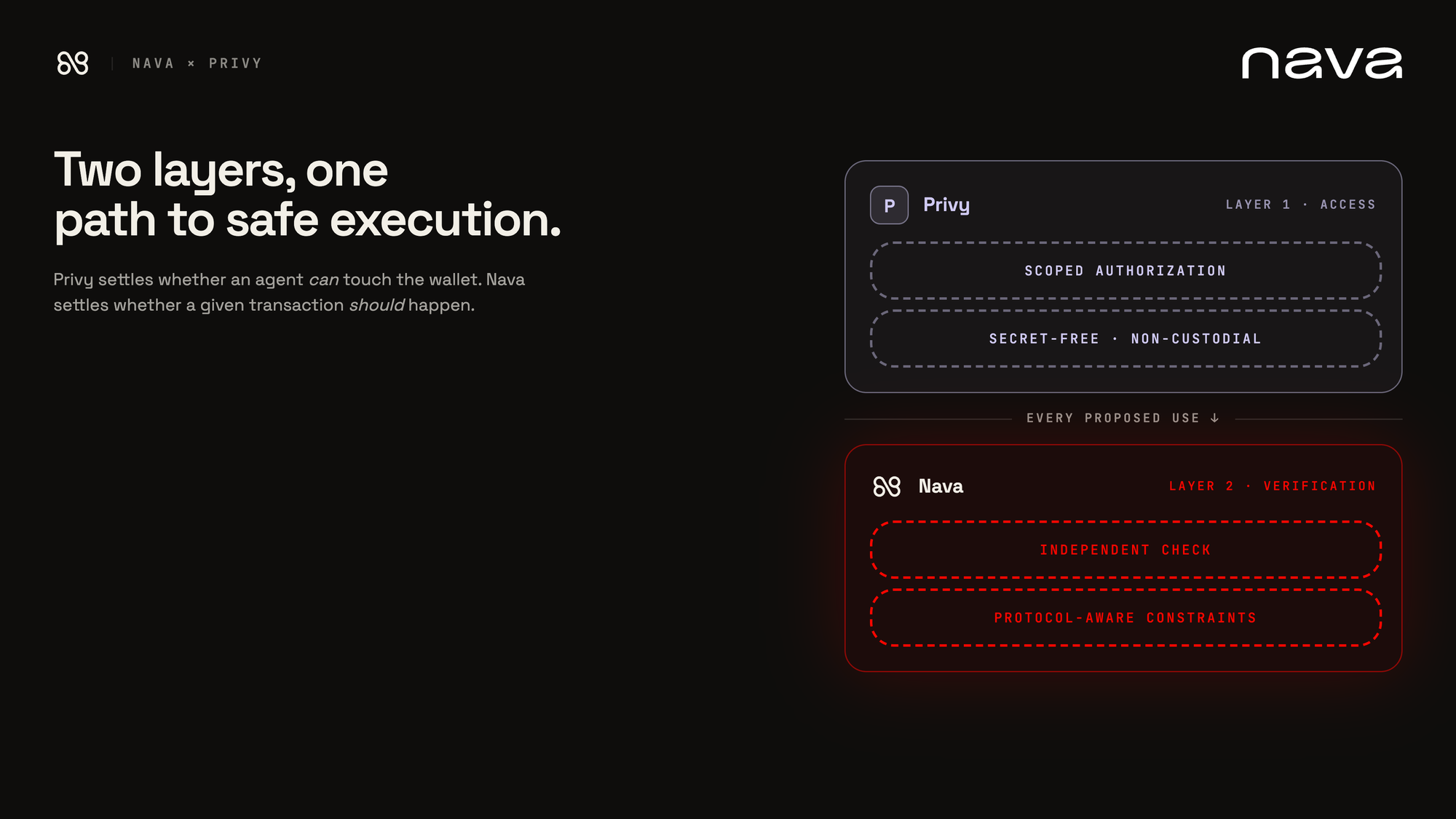
These are low-level, wallet-action rules: a secure foundation any agent can stand on. They settle whether the agent can touch the wallet. They do not settle whether a given transaction should happen. That is where Nava begins.
From scoped access to verified execution
Scoped access lets an agent reach a wallet. It does nothing to judge what the agent does once it gets there. Nava sits in that gap. Every transaction an agent proposes passes through Nava before it can execute, and the model that reviews it is separate from the agent that produced it. That independence matters: the same reasoning that lets an agent act creatively is the reasoning you cannot fully trust to grade its own work, so a second, isolated check evaluates the proposal on its own terms.
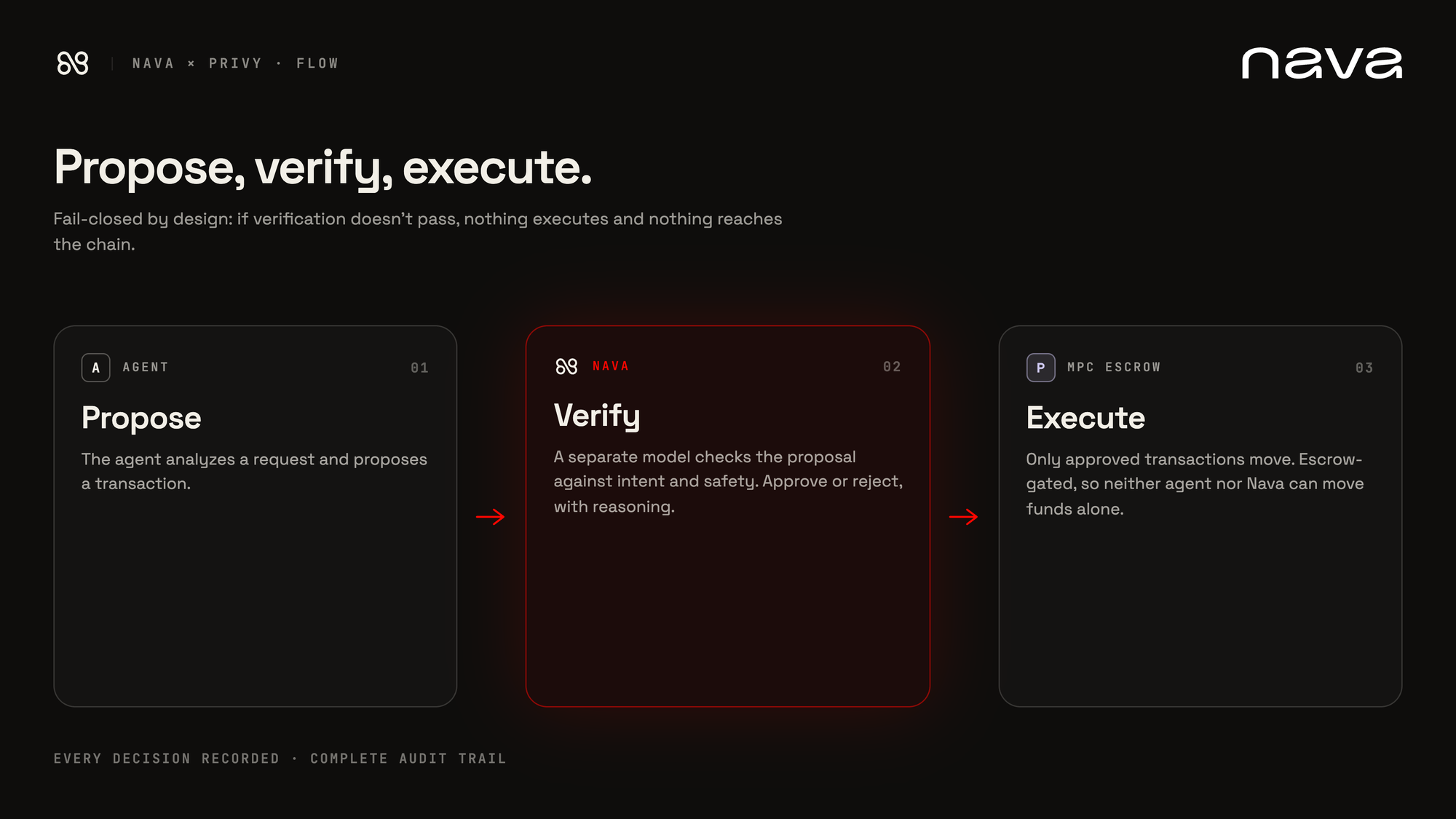
The flow is propose → verify → execute. The agent analyzes a request and proposes a transaction. Nava verifies that proposal against the user's intent and a set of protocol-aware safety checks, returning an approve or reject decision along with the reasoning behind it. Only an approved transaction moves forward, and execution is escrow-gated through multi-party computation, so neither the agent nor Nava can move funds alone. The system is fail-closed by design: if verification does not pass, nothing executes and nothing reaches the chain. Every decision is recorded, leaving a complete audit trail of what was proposed, what was approved or blocked, and why.
No secrets, no proxy, no blind trust
Giving agents wallet access has typically forced a bad choice. Embed credentials in the agent and any compromise of the environment exposes the wallet. Route everything through a custom backend and you add latency and engineering overhead to every request.
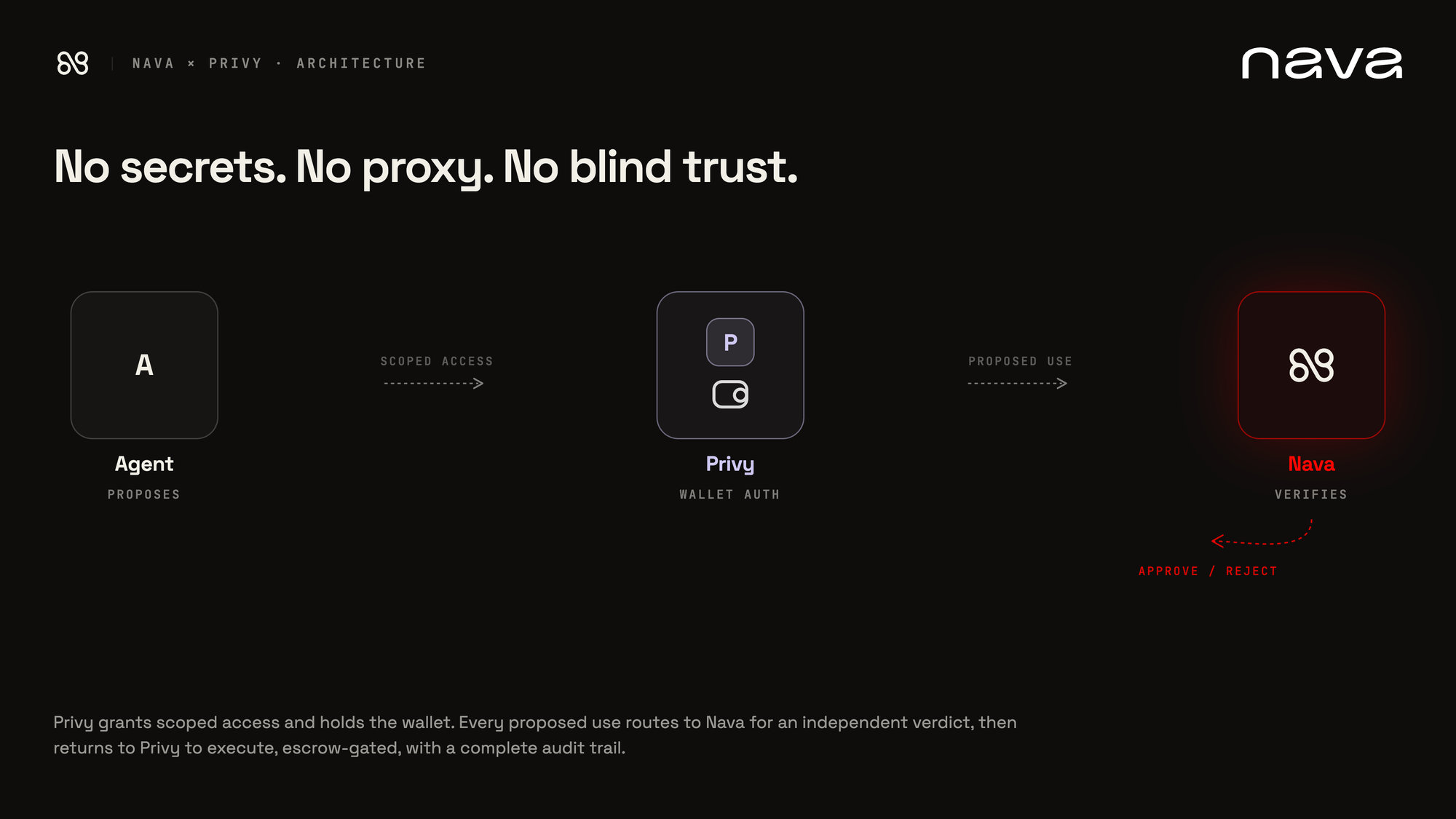
The two-layer model removes that choice: Privy grants scoped, secret-free access at the wallet, and Nava verifies every proposed use of that access before anything is signed, with a complete audit trail and non-custodial key management throughout. You ship faster, and your users get a safer way to let agents act on their behalf.
Today
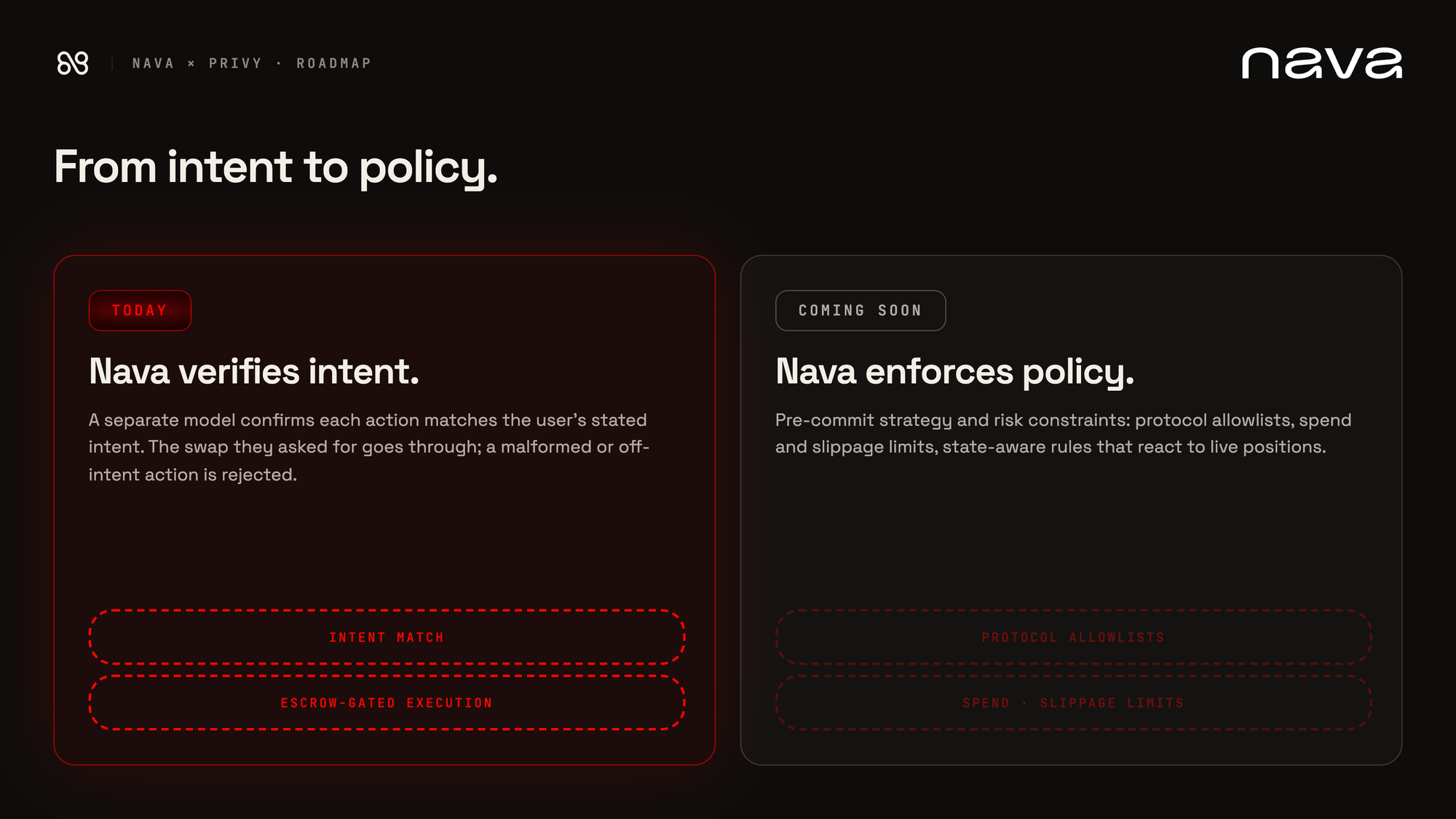
Today, Nava verifies intent. A separate model evaluates each proposed action and confirms it matches the user's stated intent. A swap your user actually asked for goes through; a malformed, manipulated, or off-intent action is rejected. Execution is escrow-gated, so anything that fails review never reaches the chain.
Coming soon
Coming soon, Nava enforces policy. You and your users will be able to pre-commit strategy and risk constraints ahead of time, including protocol allowlists, spend and slippage limits, and state-aware rules that react to live positions and market conditions. Every action is then checked against those standing constraints, not just the immediate intent. Intent verification confirms a single action is what the user meant. Policy enforcement guarantees the agent stays inside durable rules across every action it ever takes.
Get started
Bring your own agent, use Privy's scoped authorization for wallet access, and add Nava verification on top, all without embedding a Privy app secret or signing key in your agent. You keep your stack, you keep your keys out of the agent, and every transaction gets independently verified before it executes.
See it end to end in the demo above, check out the Privy Agent Sandbox, read the docs, or follow along on X.
Join the waitlist for private testnet → https://navalabs.ai/#contact

Turning your Copilot into a Financial Agent
My first trading agent placed a real ETH short before I could approve it. Nothing went wrong, but nothing would have stopped it either. Four levels of financial autonomy, why a prompt is not a mandate, and why the limits on an agent have to live outside the model.
Anatomy of a DeFi Trading Agent (and Its Missing Layer)
We reviewed 20+ DeFi trading agents. They've all converged on the same architecture, and the same weak spot: the risk gating step between LLM decision and onchain execution. Here's the anatomy of the gap, why prompt engineering can't close it, and what an independent execution gate looks like.
Auditable LLM Arbiter for DeFi Security
The gap between what you tell an agent and what it actually executes onchain is real, exploitable, and unsolved. Nava's Arbiter combines deterministic rules with semantic reasoning to verify intent-to-transaction alignment before funds move. Peer-reviewed at NDSS 2026.