Nava AI | Trust Infra for the Agentic Economy
AI agents are trading, lending, and staking with real money, unverified and unaccountable. Nava's verification layer sits between every agent decision and onchain execution, catching intent misalignment, parameter errors, and adversarial inputs before funds move. Read the full whitepaper.

Written by Nava Labs

Verification infrastructure for the agentic economy
AI agents are already trading, lending, staking, and executing complex DeFi strategies with real money. The problem is not that they lack capability. The problem is that nothing currently verifies whether what an agent executes actually matches what it was told to do. One misread instruction, one decimal error, one adversarial input, and funds are gone with no record of what happened.
Nava sits in that gap. Between the agent's decision and its execution. Before funds move.
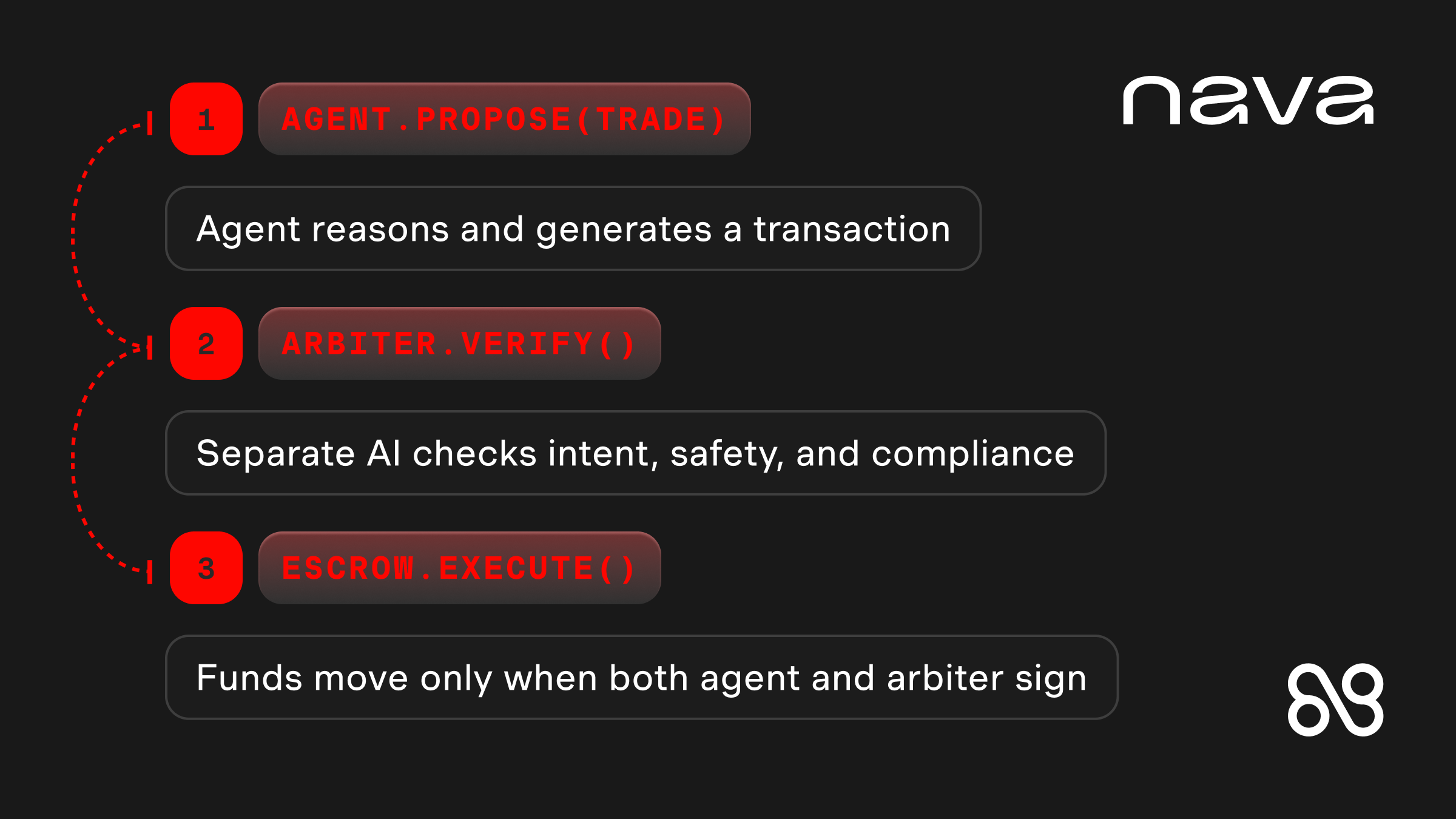
The core engine, the Arbiter, uses a Graph-of-Thought verification framework to decompose every proposed transaction into a structured set of checks: intent alignment, protocol safety, parameter validity, and adversarial detection. Every node in the graph produces an auditable result. The full reasoning trail is posted onchain. Only transactions that pass verification proceed to execution.
This research has been peer-reviewed and accepted at NDSS 2026.
The core infrastructure will be available for testing soon: Uniswap protocol policies & verification support, the Arbiter verification engine; a TypeScript or Python SDK with API-key gated agent registration; and testnet transaction logging as the onchain audit layer. The full execution and escrow lifecycle, expanded protocol support and mainnet data logging will be available in future releases beyond that.
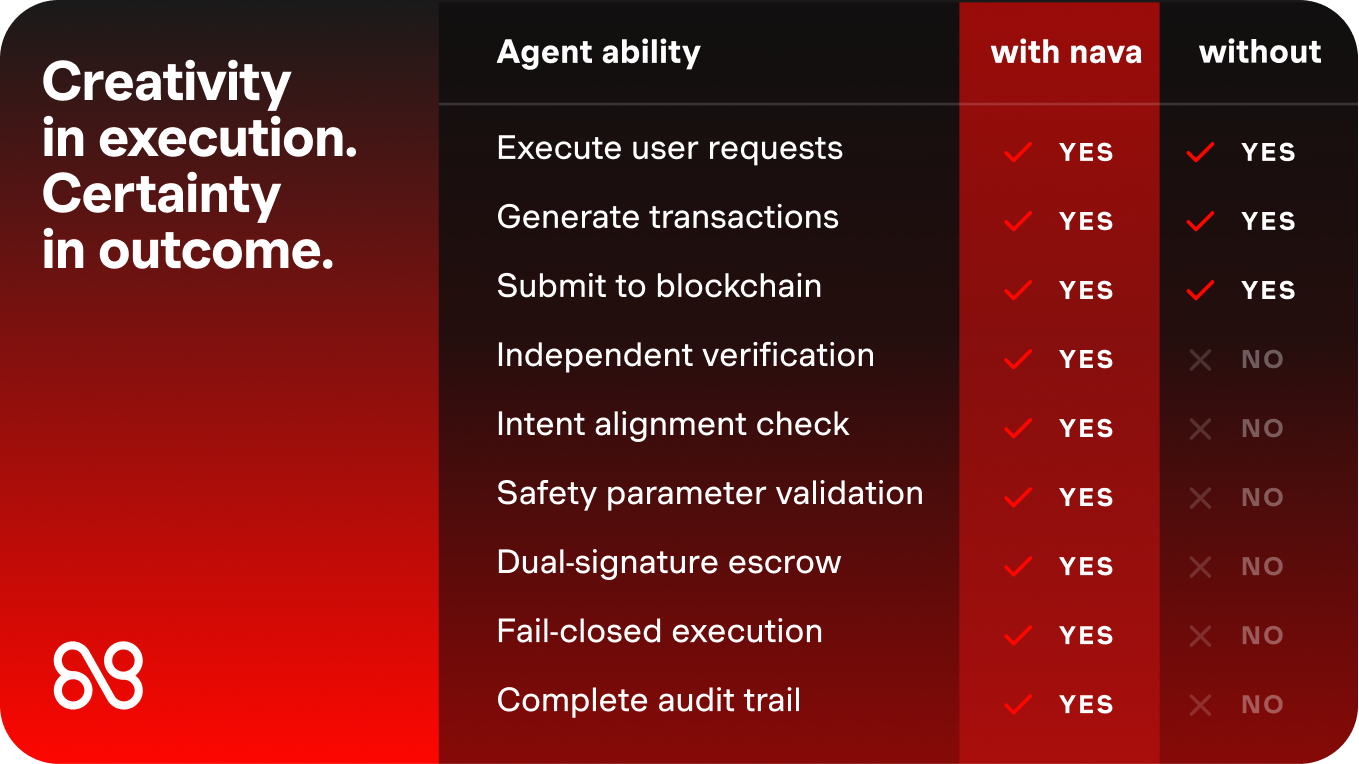
The longer-term roadmap builds the full financial stack on top of this verification foundation: payment facilitation, chargeback infrastructure for agent-to-service payments, and NavaUSD as a payment-grade stablecoin with native dispute resolution. The verification layer is the foundation. Everything else compounds on top of it.
For the full architecture, implementation status, and research detail, read the whitepaper.
👉 Read the whitepaper (coming soon)
If you are building agents that need to handle real capital, the private testnet is open. Join the waitlist and get early access.
👉 Join the waitlist → https://navalabs.ai/#contact
Turning your Copilot into a Financial Agent
My first trading agent placed a real ETH short before I could approve it. Nothing went wrong, but nothing would have stopped it either. Four levels of financial autonomy, why a prompt is not a mandate, and why the limits on an agent have to live outside the model.
Nava x Privy: Enabling AI Agents to Transact from Wallets Securely
Nava gives AI agents secure, scoped access to user wallets built on Privy. No app secrets, backends, or private keys. One browser-based OAuth flow spans CLIs, MCP servers, and skills, so agents transact autonomously within boundaries we control.
Anatomy of a DeFi Trading Agent (and Its Missing Layer)
We reviewed 20+ DeFi trading agents. They've all converged on the same architecture, and the same weak spot: the risk gating step between LLM decision and onchain execution. Here's the anatomy of the gap, why prompt engineering can't close it, and what an independent execution gate looks like.